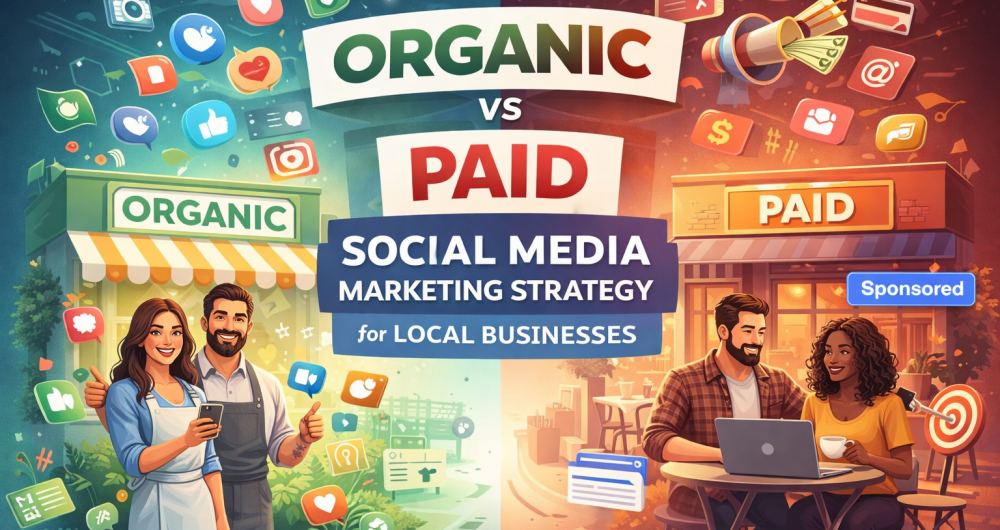
Organic vs Paid: The Best Social Media Marketing Strategy for Local Businesses
If you run a local business, you have probably asked yourself this question at least once:
“Should I focus on organic social media or spend money on paid ads?”
It is one of the biggest decisions local businesses make when building their online presence.
Whether you own a café, salon, gym, clothing store, real estate agency, dental clinic, or small service-based business, social media can help you attract more customers than ever before. But with limited budgets and increasing competition, you need to know where your time and money should go.
The truth is that both organic and paid social media have value. However, they work in very different ways.
Organic content helps people know, trust, and remember your business. Paid advertising helps you reach more people quickly and turn attention into leads or sales.
The smartest local businesses in 2026 are not choosing one over the other. They are learning how to combine both.
In this blog, we will break down the difference between organic and paid social media, the pros and cons of each, and the best strategy local businesses should use to grow.
What Is Organic Social Media?
Organic social media refers to the content you post for free on your social media pages.
This includes:
Regular Instagram and Facebook posts
Reels and short-form videos
Stories
Community updates
Behind-the-scenes content
Customer testimonials
Tips, educational posts, and local information
When you post organically, you are not paying the platform to show your content to more people. Instead, your content is shown naturally to your followers and sometimes to new people if it performs well.
For local businesses, organic content is often the first impression customers get.
Imagine someone searches for your business on Instagram. Before they call, visit, or message you, they will likely scroll through your page.
They want to see:
Are you active?
Does your business look trustworthy?
What kind of experience do customers have?
What makes you different?
Organic content answers these questions.
Why Organic Social Media Matters for Local Businesses
Many local businesses underestimate the power of organic content because it does not always bring instant results.
But organic social media builds something more important: trust.
People buy from businesses they feel connected to.
When you regularly post useful, interesting, and authentic content, customers begin to recognize your brand. Over time, they become more likely to visit, message, recommend, or purchase from you.
For example, if you own a local bakery, you might post:
Fresh products coming out of the oven
Customer reactions
Behind-the-scenes videos
Staff introductions
Special offers for festivals or weekends
Even if someone does not buy immediately, they may remember your business later when they need it.
That is the long-term value of organic social media.
Benefits of Organic Social Media
Builds trust and credibility
Creates a loyal audience
Strengthens your brand personality
Helps existing customers stay connected
Costs very little except time and effort
Makes your business feel more human
Challenges of Organic Social Media
Organic marketing is powerful, but it is not perfect.
The biggest challenge is reach.
Social media platforms no longer show your posts to everyone who follows you. In many cases, only a small percentage of your audience sees each post.
Organic growth is also slower. It can take weeks or months to build an engaged audience.
If you need immediate leads or quick sales, relying only on organic content may not be enough.
What Is Paid Social Media?
Paid social media means spending money to promote your content or run advertisements.
Examples include:
Facebook ads
Instagram ads
Boosted posts
Local lead generation campaigns
Video ads
Retargeting campaigns
Click-to-call or click-to-message ads
With paid advertising, you can choose exactly who sees your content.
For example, if you own a salon in your city, you can show your ad only to women aged 18–40 who live within 10 kilometers of your location and are interested in beauty, skincare, or fashion.
This level of targeting is what makes paid social media so effective.
Instead of waiting for people to discover you naturally, you can put your business directly in front of the right audience.
Why Paid Social Media Matters for Local Businesses
The biggest advantage of paid social media is speed.
If you want more calls, more website visits, more bookings, or more customers this week, paid ads can help you get results much faster than organic content.
For example:
A restaurant can run an ad for a new lunch offer.
A gym can promote a free trial membership.
A dentist can advertise a discount on teeth cleaning.
A real estate agent can promote a property listing.
Within a few hours, hundreds or even thousands of local people can see the offer.
Paid ads are especially useful when:
You are launching a new business
You want quick visibility
You are promoting a limited-time offer
You need more leads fast
You want to target a specific audience
Benefits of Paid Social Media
Reaches more people quickly
Highly targeted based on location, age, interests, and behavior
Generates faster leads and sales
Easy to measure and track results
Helps you compete with larger businesses
Challenges of Paid Social Media
The downside is that paid advertising costs money.
And if your content, targeting, or offer is weak, you can waste your budget quickly.
Many local businesses make the mistake of running ads without a strategy. They spend money promoting a random post and then wonder why they do not get results.
Another challenge is that paid ads stop working as soon as you stop spending.
Organic content can continue bringing value for weeks. Paid ads usually disappear when the budget ends.
That is why paid ads should never be your entire strategy.
Organic vs Paid: Which One Is Better?
The honest answer is: neither.
Organic and paid social media do different jobs.
Organic builds trust.
Paid creates reach.
Organic keeps people engaged.
Paid brings faster action.
Organic is your long-term strategy.
Paid is your short-term accelerator.
Think of it like this:
Organic content is the foundation of your house.
Paid advertising is the fuel that helps more people find it.
If you only use organic content, growth may be too slow.
If you only use paid ads, people may click on your profile, see an empty or inactive page, and leave.
The best local businesses use both together.
The Best Strategy for Local Businesses in 2026
In 2026, local businesses need a balanced strategy.
A smart formula is:
70% organic content
30% paid promotion
Why?
Because organic content builds your identity, while paid ads increase your reach.
Here is how that strategy works:
Step 1: Build a Strong Organic Presence
Before spending money on ads, make sure your social media pages look professional and active.
You should have:
A clear profile photo and bio
Updated contact information
Good-quality posts and videos
Customer reviews and testimonials
Consistent branding
Post content regularly, such as:
Behind-the-scenes videos
Customer success stories
Tips related to your industry
Team introductions
Frequently asked questions
Reels with trending audio
For example, if you own a café, you might post:
A video of coffee being prepared
“3 Most Loved Drinks This Week”
Customer reviews
A story showing the café atmosphere
This makes your page feel active and trustworthy.
Step 2: Promote Your Best Content With Paid Ads
Do not spend money on every post.
Instead, look at which organic posts are already performing well.
If a reel, testimonial, or offer gets more likes, shares, or comments than usual, promote that content.
Why?
Because if people already like it organically, it will likely perform even better with paid reach.
For local businesses, the best-performing ads are usually:
Customer testimonials
Before-and-after transformations
Limited-time offers
Short videos
Reels showing real results
For example, a salon might boost a reel showing a haircut transformation.
A gym might promote a member success story.
A bakery might run an ad for a festival special box.
Which Platforms Should Local Businesses Focus On?
Not every social media platform is equally important for local businesses.
In 2026, these are the most useful platforms:
Best for:
Cafés
Salons
Clothing stores
Gyms
Food businesses
Beauty brands
Instagram works well because people love visual content. Reels, stories, and local hashtags can help your business get discovered.
Best for:
Service businesses
Real estate
Clinics
Local shops
Community-based businesses
Facebook is still powerful for local ads, groups, and events.
Google Business Profile
Even though it is not exactly social media, it is extremely important.
Local businesses should regularly upload:
Photos
Reviews
Updates
Offers
Many people discover local businesses through online searches before they ever visit social media.
TikTok and Short-Form Video Platforms
If your audience is younger, short-form video can help you reach a huge number of people organically.
Simple, authentic videos often perform surprisingly well.
Common Mistakes Local Businesses Make
Many businesses fail because they either:
Post randomly with no plan
Run ads without good content
Stop too early
Focus only on followers instead of customers
Copy competitors without creating their own identity
Social media is not only about being seen.
It is about creating trust and giving people a reason to choose you.
A local business with 2,000 engaged followers can often make more sales than a business with 20,000 followers who do not care.
The goal is not to become famous.
The goal is to become the first business people think of when they need your product or service.
Final Thoughts
When it comes to organic vs paid social media, there is no single winner.
Organic content helps local businesses build relationships, trust, and long-term brand value.
Paid advertising helps local businesses reach the right people faster and generate immediate results.
The best strategy is to use both together.
Create strong, authentic organic content first. Then use paid ads to amplify what is already working.
In 2026, the local businesses that grow the fastest will not necessarily be the ones with the biggest budgets.
They will be the ones that understand their audience, tell real stories, stay consistent, and use social media with a clear strategy.
Because at the end of the day, people do not follow businesses.
They follow businesses that make them feel something.